Trivalent Chromium Passivation process that consists in producing a layer composed mainly of
chromium compounds. The base material is treated with solutions containing trivalent chromium
compounds appropriate to the purpose. The base material is involved in the forming of the layer.
This allows for the incorporation of elements both from the substrate and from the treatment
media. These layers are called chemical conversion layers.
PROPERTIES
The layer obtained from the chemical process consists mainly of trivalent chromium compounds and a small quantity of aluminum oxide. A homogeneous layer that closely follows the outlines of edges, cavities and relieves is obtained.
Replacement for conventional hexavalent chromium passivation
Corrosion protection is very good even without any subsequent surface treatment. Meets or exceeds MIL-DTL-5541 for bare corrosion resistance (≧336 hours per ASTM B 117)
Low contact resistance, meets electrical conductivity requirements per MIL-DTL-81706, Class 3
Temper resistance up to 100℃ with minimal loss in corrosion resistance.
This coating serves as primer for subsequent layers of paint.
MATERIALS
TAlmost any aluminum alloys and various castings can be chromated.
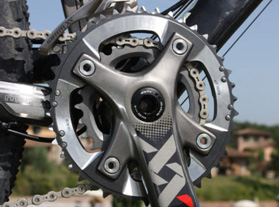
Crank set for bike, Trivalent chromating.
APPLICATIONS
Trivalent chromate layers can be used in :
Automotive industry (as a primer for rubber/metal bonds, corrosion protection of parts with or without a final hand of paint and as an agent that enhances adhesion and the weather resistance of paints...)
Machine and precision engineering (corrosion protection...)
Facades (for paint adhesion and corrosion protection...)
Electronics industry (corrosion protection, electrical conductivity, EMC...)